
External Audit Tender Evaluation Criteria: Choosing the Right Auditor
25 November 2026 · 12 min read
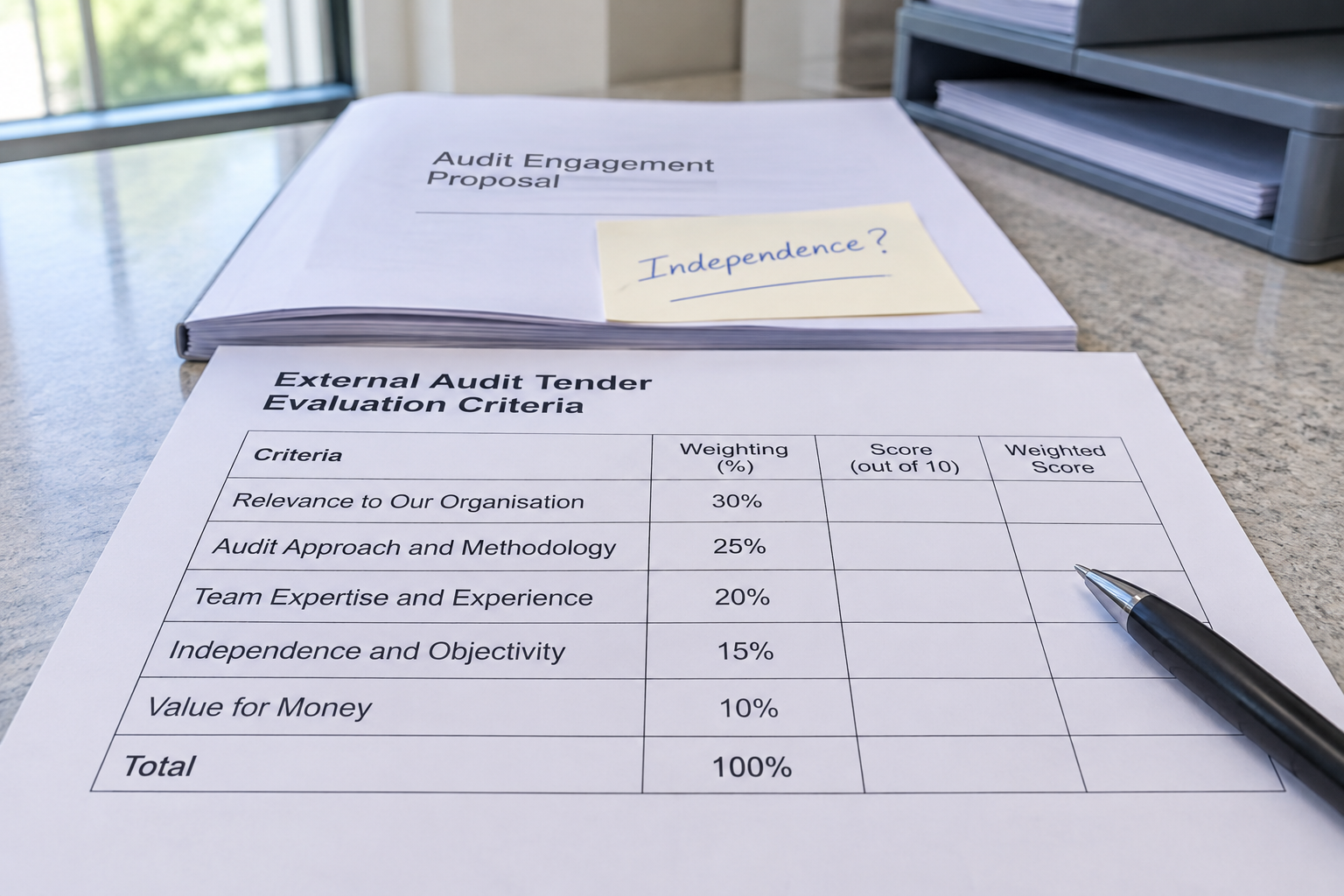
External audit tender evaluation criteria help buyers compare audit firms on the factors that matter most: independence, audit quality, relevant experience, the proposed team, delivery and fees. Set the criteria and their weightings before inviting bids, request comparable evidence, and record the reasons for your scores. The final appointment should remain a decision for named people, not an AI tool.
What Are External Audit Tender Evaluation Criteria?
They are the standards you use to assess competing proposals for an external audit. They turn a broad question—“Which firm should we appoint?”—into a set of specific, evidence-based judgements. The right criteria depend on the organisation, the audit’s scope and any legal or regulatory requirements that apply.
For a statutory audit, the buyer’s objectives typically include obtaining a high-quality, independent audit delivered by a suitably eligible firm. For other external assurance engagements, eligibility and reporting requirements may differ. Describe the engagement accurately in the invitation rather than assuming every supplier will interpret “audit” in the same way.
A practical framework separates three decisions:
- Eligibility: can the firm meet the mandatory conditions for the engagement?
- Quality: how well does its proposal address your risks, requirements and timetable?
- Commercial value: are the proposed fees and terms clear and proportionate to the work?
Tell bidders which requirements are mandatory, which will be scored and how any minimum thresholds work. A bidder should be able to understand what a strong answer looks like without guessing at hidden preferences.

For a broader introduction to setting criteria and documenting scores, see our step-by-step guide to tender evaluation criteria.
Which Criteria Should Buyers Include?
Start with the risks and practical demands of your engagement. A group with overseas subsidiaries, for example, may need to understand how a proposed auditor coordinates work across jurisdictions. A smaller organisation may place particular emphasis on access to the senior team and a realistic timetable. Neither should use size as a substitute for evidence of competence.
| Criterion | What to assess | Evidence to request |
|---|---|---|
| Independence and conflicts | Whether the firm can meet applicable independence requirements and identify relevant threats | A conflict declaration, relevant relationships and proposed safeguards |
| Audit approach and quality | How the firm plans, challenges, reviews and delivers the audit | A tailored methodology, risk assessment and quality review arrangements |
| Relevant experience | Experience relevant to your sector, reporting framework and organisational complexity | Comparable engagement descriptions and references, subject to confidentiality |
| Proposed team | Skills, senior involvement, capacity and continuity | Named roles, relevant experience, responsibilities and availability |
| Delivery and communication | Whether milestones, escalation routes and reporting meet your needs | A proposed timetable, communications plan and dependencies |
| Fees and commercial terms | Clarity, completeness and value of the proposed fee | A fee breakdown, assumptions, expenses and change-control approach |
Each heading needs a question that prompts useful evidence. “Tell us about your quality” is too broad. A stronger prompt is: “Explain how the engagement partner and an independent reviewer will challenge significant judgements on this audit, and identify the stages at which that review will take place.” Adapt the question to the review arrangements relevant to your engagement.
Ask for enough detail to compare proposals, but avoid requesting material you do not intend to evaluate. If you ask for references, explain whether and how you will use them, and apply the same approach to every bidder. Do not rely on a polished presentation alone: check that the proposal identifies who will do the work and how.
How Should Independence and Eligibility Be Assessed?
Independence is not simply a feature to reward with extra points. Where a requirement is mandatory, treat it as a gate: a bid that cannot meet the applicable condition should not proceed merely because it scores well elsewhere. State the gate, required evidence and consequences in the tender documents.
Ask each firm to declare relationships and services that could affect its independence, including relevant work for your organisation or connected entities. Ask it to explain any identified threats and how it proposes to address them. A declaration is a starting point, not a replacement for professional judgement or the firm’s own independence procedures.
For a UK statutory audit, check the firm’s eligibility and the relevant ethical requirements for your circumstances. The Financial Reporting Council publishes standards and guidance relevant to audit and auditor independence. Depending on your organisation and engagement, additional requirements may apply; seek appropriate professional advice rather than treating a general checklist as a legal determination.
Record who reviewed each declaration, what was checked and whether any clarification was needed. If a response is unclear, ask a focused question and keep the answer with the evaluation record. Apply the same eligibility rules consistently, while recognising that the facts disclosed by different firms may require different follow-up questions.

How Do You Weight External Audit Tender Evaluation Criteria?
Weightings express the relative importance of scored criteria. Agree them before bids are received, and disclose them along with the scoring method. Mandatory eligibility checks sit outside the scored model in the example below: they must be passed before a proposal is scored.
Hypothetical example: an organisation inviting proposals for an external audit could choose the following split. These figures illustrate a method, not a recommended formula or a substitute for the rules governing a particular procurement.
| Scored criterion | Example weighting | Why it matters |
|---|---|---|
| Audit approach and quality | 35% | Tests how the firm will respond to the engagement’s risks and exercise challenge |
| Team and relevant experience | 25% | Assesses the people and expertise proposed for the work |
| Delivery and communication | 15% | Tests whether the audit can be coordinated and issues escalated effectively |
| Fees and commercial terms | 25% | Compares the complete offer and the assumptions behind it |
| Total | 100% | Eligibility is assessed separately |
Adjust the split to reflect the engagement. If a complex group audit depends heavily on coordination across locations, make that explicit within the relevant quality or delivery criterion. If team continuity is particularly important, explain how it will be assessed rather than leaving evaluators to infer its importance.
Make sure subcriteria add up to their parent weight and do not reward the same evidence twice without a clear reason. For instance, sector experience may inform both the proposed approach and the team assessment, but the questions should test distinct things: the first asks how the firm will address sector risks; the second asks whether the named people have the relevant skills.
Price also needs a published method. You might compare normalised total fees for a defined scope, using a formula set out in advance. State how you will handle expenses, optional work, assumptions, missing prices and unusually low or high bids. Do not change the formula after seeing the responses simply because it produces an inconvenient ranking.
For more on turning requirements into a defensible weighting model, read our AI-assisted tender evaluation criteria scenario.
What Evidence Shows Audit Quality and Relevant Experience?
A credible response connects the firm’s method to your circumstances. Ask bidders to identify the significant risks they would expect to explore, explain their initial approach to those risks and describe how that approach would be refined during planning. An auditor should retain the professional discretion needed to determine its work; your tender is assessing the proposed approach, not prescribing an audit opinion.
Useful questions include:
- How will the team identify and respond to significant risks relevant to this organisation?
- What involvement will the engagement partner and other senior staff have at key stages?
- How will the firm review difficult judgements and resolve differences of view?
- How will specialists or other audit teams be involved where needed?
- What information and access will the firm need from us, and by when?
Request examples that are genuinely comparable, while allowing firms to protect client confidentiality. A list of prominent clients does not establish that the proposed team can handle your requirements. Look instead for the nature of the work, the complexity involved and the responsibilities of the people proposed for your engagement.
Consider the firm’s quality management arrangements alongside the engagement-specific plan. The International Auditing and Assurance Standards Board provides information on international auditing and quality management standards. Check which standards and local requirements apply before deciding what evidence to request.
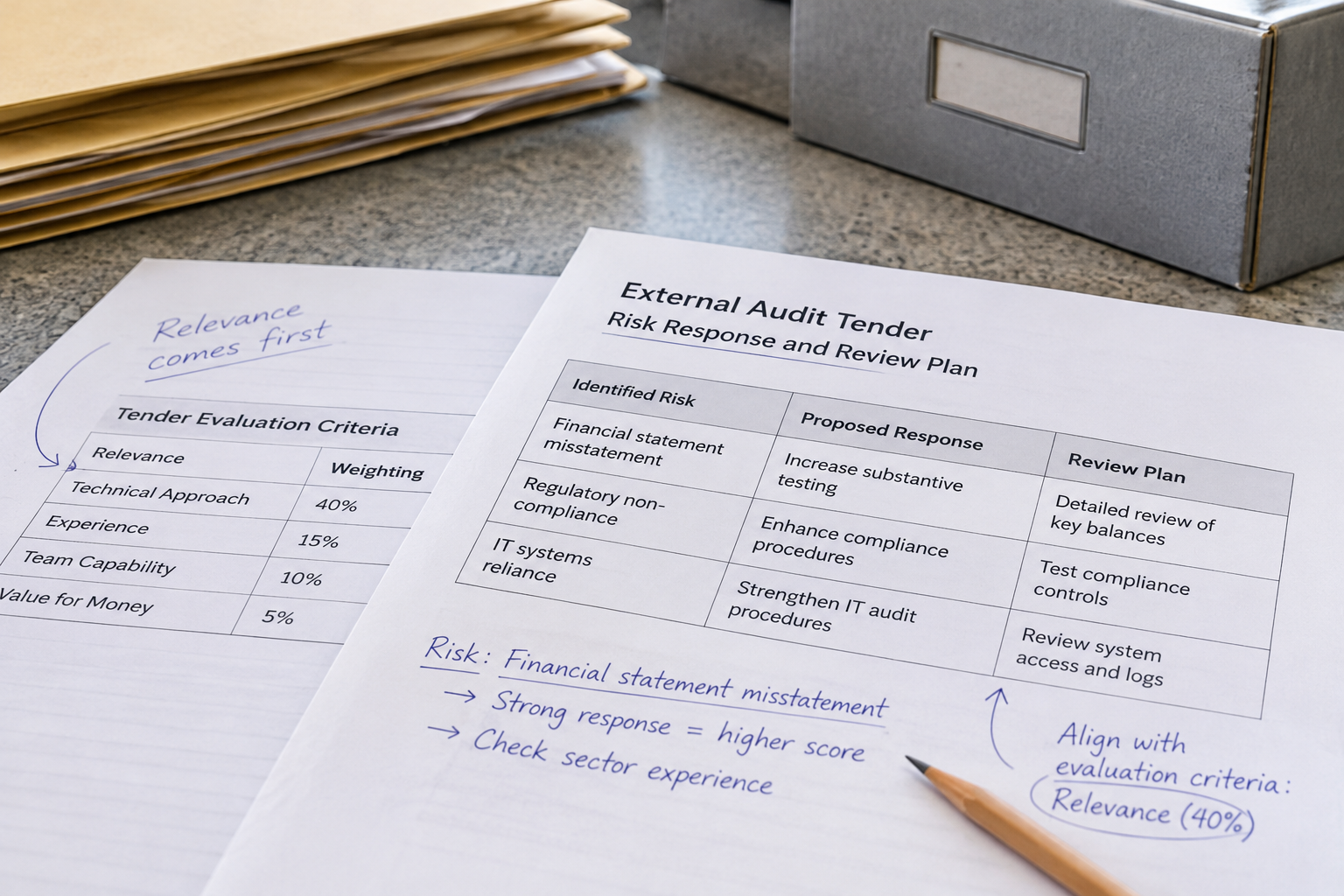
Be alert to responses that promise extensive senior involvement without showing when it will happen, or describe a generic methodology without addressing your reporting framework. Those are reasons to seek clarification or score against your published descriptors—not reasons to invent requirements after the deadline.
How Can You Compare Fees Fairly?
Give every bidder the same scope and pricing template. Specify the entities, periods, expected deliverables and any known timetable constraints. Ask firms to identify assumptions about the records, support and access they expect from your team. If the scope includes optional services, ask for those prices separately so the core audit can be compared consistently.
Review the fee alongside the proposed work. A low headline price may exclude expenses or depend on significant preparation by your staff. A higher fee may include work that falls outside the requested scope. Neither is automatically better value: evaluators need to understand what is included before applying the published commercial scoring method.
Ask how changes will be agreed if circumstances alter, including who can approve additional work and how fees will be communicated. If a bidder proposes a material qualification, assess it using the process and criteria stated in the invitation. Keep commercial negotiation distinct from the initial evaluation where your procurement rules require it.
A short clarification log can make the comparison more reliable: note the original assumption, the question sent, the answer received and its effect on the assessment. Do not use clarification to let one bidder rewrite a weak proposal unless your published process and applicable rules permit that opportunity.

How Should a Panel Score and Document Its Decision?
Choose evaluators with the knowledge to assess the bids and declare any conflicts of interest before they start. The panel might include finance, procurement and governance representatives, with specialist input where appropriate. Confirm who will make the appointment recommendation and who has authority to approve it under your organisation’s arrangements.
Use a scoring scale with descriptions anchored to evidence. For example, you could define a five-point scale in which a response receiving the highest mark fully addresses the question with convincing, engagement-specific evidence, while the lowest mark provides no relevant response. Explain the intervening scores and publish the scale with the tender.
For each scored answer, ask evaluators to cite the relevant response and explain why it meets the descriptor. Record strengths, gaps and any material assumptions. A comment such as “good team” is hard to defend; a more useful note identifies the proposed roles, their relevant experience and how those details meet the published criterion.
- Check eligibility and record the outcome before quality scoring.
- Review eligible bids against the same questions, criteria and scale.
- Capture individual scores and evidence references before moderation, if that is your chosen process.
- Discuss differences and document the agreed score and reasoning.
- Apply the published weights and pricing method, then check the arithmetic.
- Record the recommendation, approvals and any required bidder communications.
For sealed bidding, make the submission deadline and opening process clear. Keeping bids inaccessible until the deadline helps prevent early responses from influencing later ones. Our sealed bidding process walkthrough explains the practical steps.
TenderLock can help structure requirements and weighted criteria, keep bids locked until the deadline, and check responses requirement by requirement. Its audit trail supports the record, while named people make the final decisions. Start your first live tender free; no card is required.

What Should You Watch for Before Appointment?
Before recommending a firm, revisit the mandatory conditions, declarations and any unresolved qualifications. Check that the proposal still matches the scope you intend to award and that the people approving the decision have the information they need. If references or additional checks are part of the process, carry them out as described in the tender documents and record the outcome.
Keep a clear distinction between a supplier’s statement and a verified fact. For example, a bidder’s description of relevant experience is evidence of what it has proposed; a reference or other appropriate check may help you assess that description. Do not represent a check as completed if it has not been completed, and do not imply that a score guarantees future audit quality.
Consider how the transition would work if the appointed auditor is different from the incumbent. Ask about a practical handover, access to information, dependencies and responsibilities, subject to the relevant professional requirements. Avoid promising bidders access to confidential information before you have authority to share it.
Finally, retain the documents needed to explain the decision: the issued criteria, bids, declarations, clarifications, scoring notes, moderation record and approval. Follow your organisation’s retention and confidentiality policies. A documented process helps the panel explain its reasoning; it does not remove the need to follow the applicable appointment and procurement rules.
Video: Understanding Audit Tender Evaluation
For another perspective on selecting an external auditor, look for guidance that distinguishes independence requirements from scored quality and commercial criteria. Check that any advice applies to your jurisdiction and type of engagement.
Frequently Asked Questions
Is the lowest audit fee the best choice?
Not necessarily. A fee is meaningful only when you understand the scope, assumptions, expenses and proposed delivery behind it. Compare prices using the method published in your tender, alongside quality and other scored criteria. If your procurement is subject to specific rules, make sure the pricing approach and award decision comply with them.
Should the incumbent auditor be assessed differently?
Assess the incumbent against the same published criteria and evidence requirements as other bidders. Its knowledge of the organisation may be relevant, but evaluators should avoid treating familiarity as an unstated advantage. Consider any applicable rotation, independence or appointment requirements before inviting or evaluating proposals.
Can we change the criteria after receiving bids?
Changing criteria or weights after bids arrive risks undermining fairness and confidence in the outcome. If a material correction is necessary, consider the applicable procurement rules and obtain appropriate advice. You may need to notify all bidders and adjust the process rather than quietly changing the scoring model.
Can AI choose the external auditor?
AI can help organise requirements, identify gaps and connect responses to evaluation questions, but it should not make the appointment decision. Named evaluators should check the source evidence, assess independence and quality, resolve scoring differences and record their reasoning. Human oversight is especially important where a response is ambiguous or professional judgement is needed.
What if a bidder does not meet a mandatory requirement?
Follow the eligibility process set out in the tender and any applicable rules. First establish whether the response genuinely fails the requirement or needs a permissible clarification. Record the evidence and decision consistently. Do not use a high quality or price score to compensate for a mandatory condition that has not been met.
Ready to put your criteria into practice? Start your first live tender free with TenderLock, with no card required.