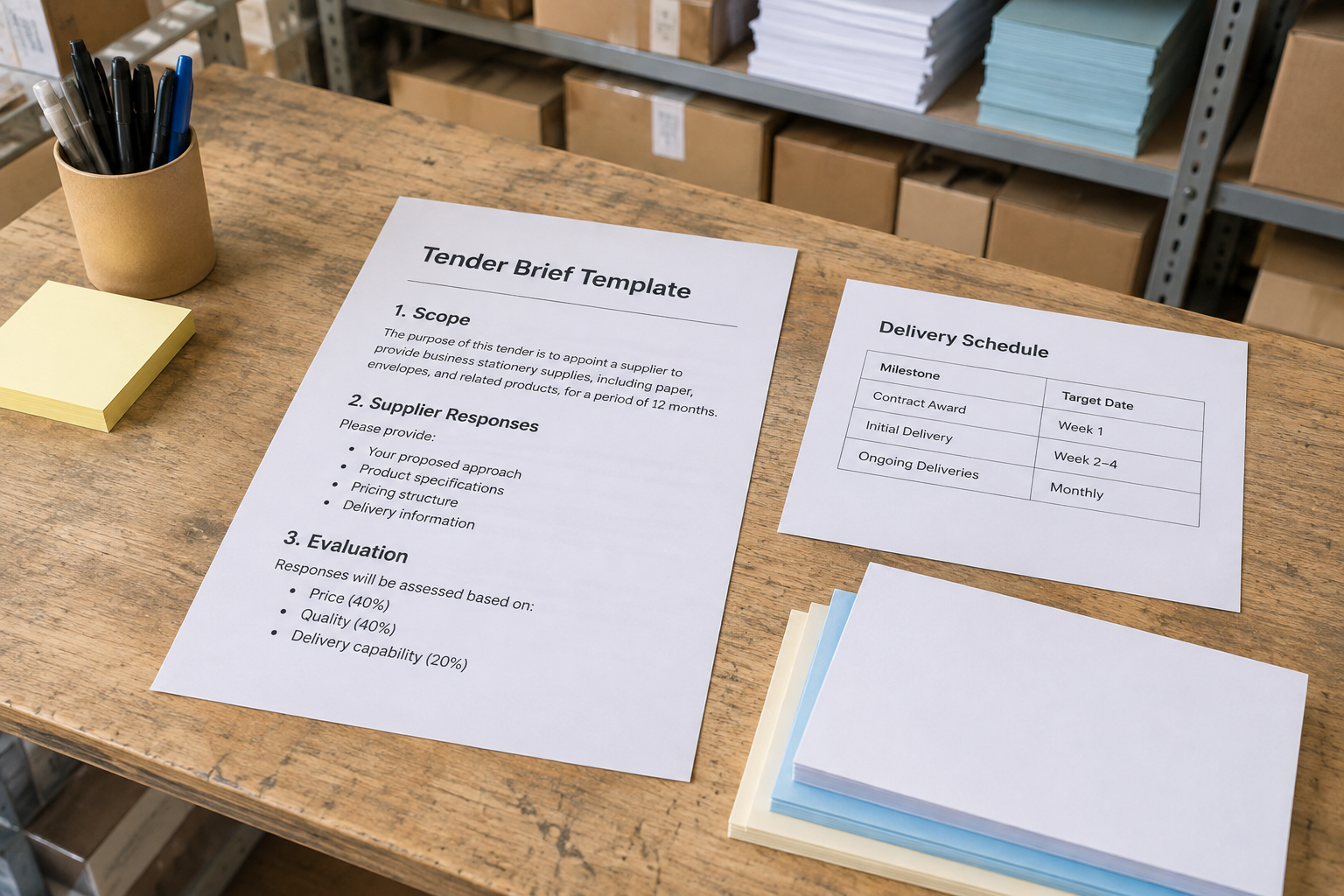
A tender brief template gives buyers a consistent way to explain what they need, how suppliers should respond and how bids will be assessed. Start with the outcome and scope, then add measurable requirements, evaluation criteria and a realistic timetable. This guide takes you from a blank page to a brief that suppliers can answer and evaluators can use.
What Is a Tender Brief and When Do You Need One?
A tender brief is the buyer’s starting document for a competitive purchasing exercise. It tells potential suppliers what is being bought, the context, the expected outcomes and the information needed to compare responses. Depending on the procurement, it may form part of a wider invitation to tender alongside a specification, pricing schedule and contract terms.
Use a brief when you need more than an informal quotation: for example, when the work has several requirements, suppliers need the same information, or you must be able to explain how a decision was reached. A proportionate brief can also help with a smaller purchase if scope or service quality matters as much as price.
Before drafting, decide who owns the purchase, who can approve the budget and who will evaluate responses. Agree what a successful outcome looks like. If those points are unclear, even a polished template will be difficult for suppliers to answer.
For public-sector buyers, this guide is a practical starting point, not a substitute for the rules that apply to your organisation and procurement. Check the relevant legislation and your internal procedures before publishing. The UK government’s Procurement Act guidance collection is a useful place to start where the Act applies.
Tender Brief Template: Copy and Complete
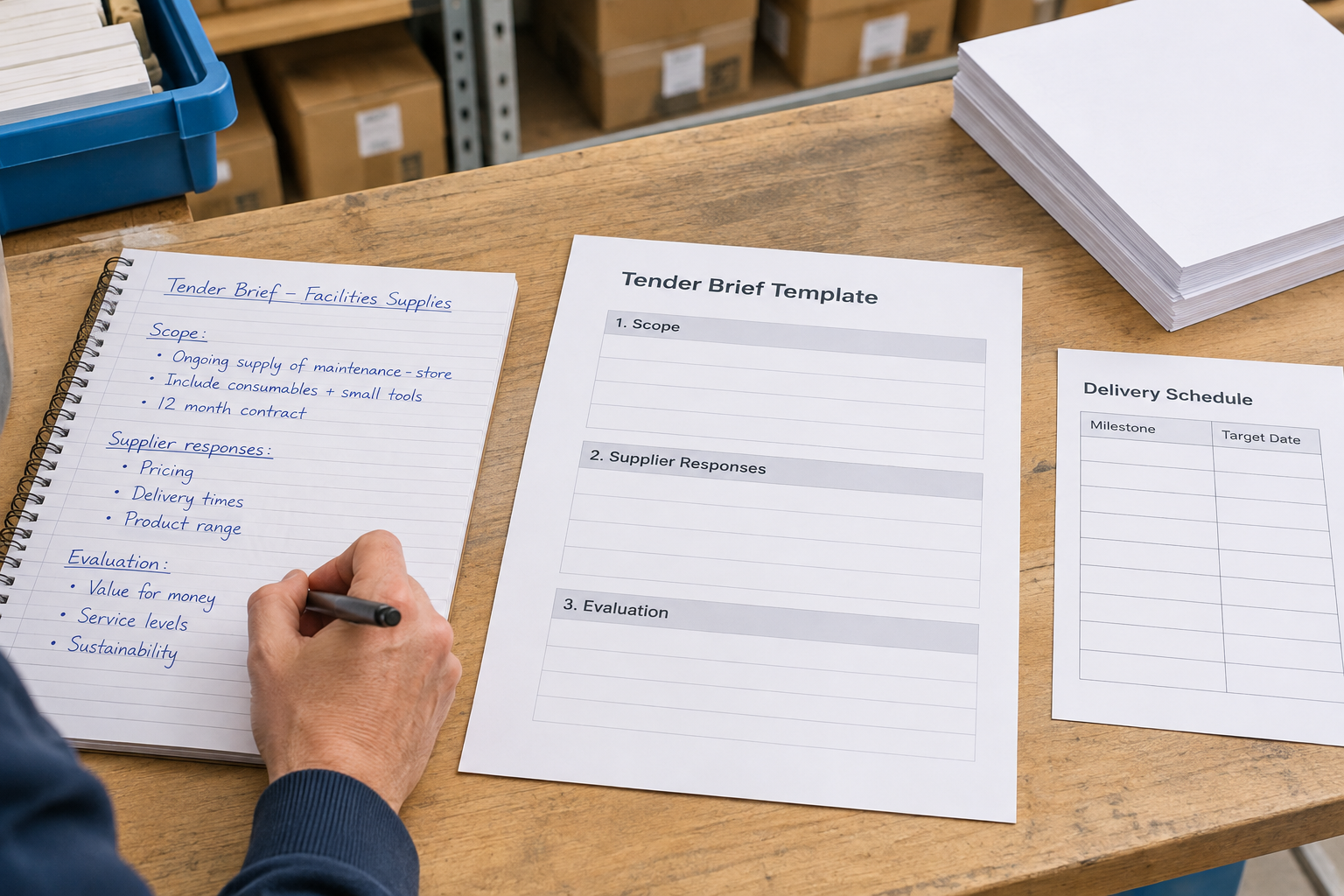
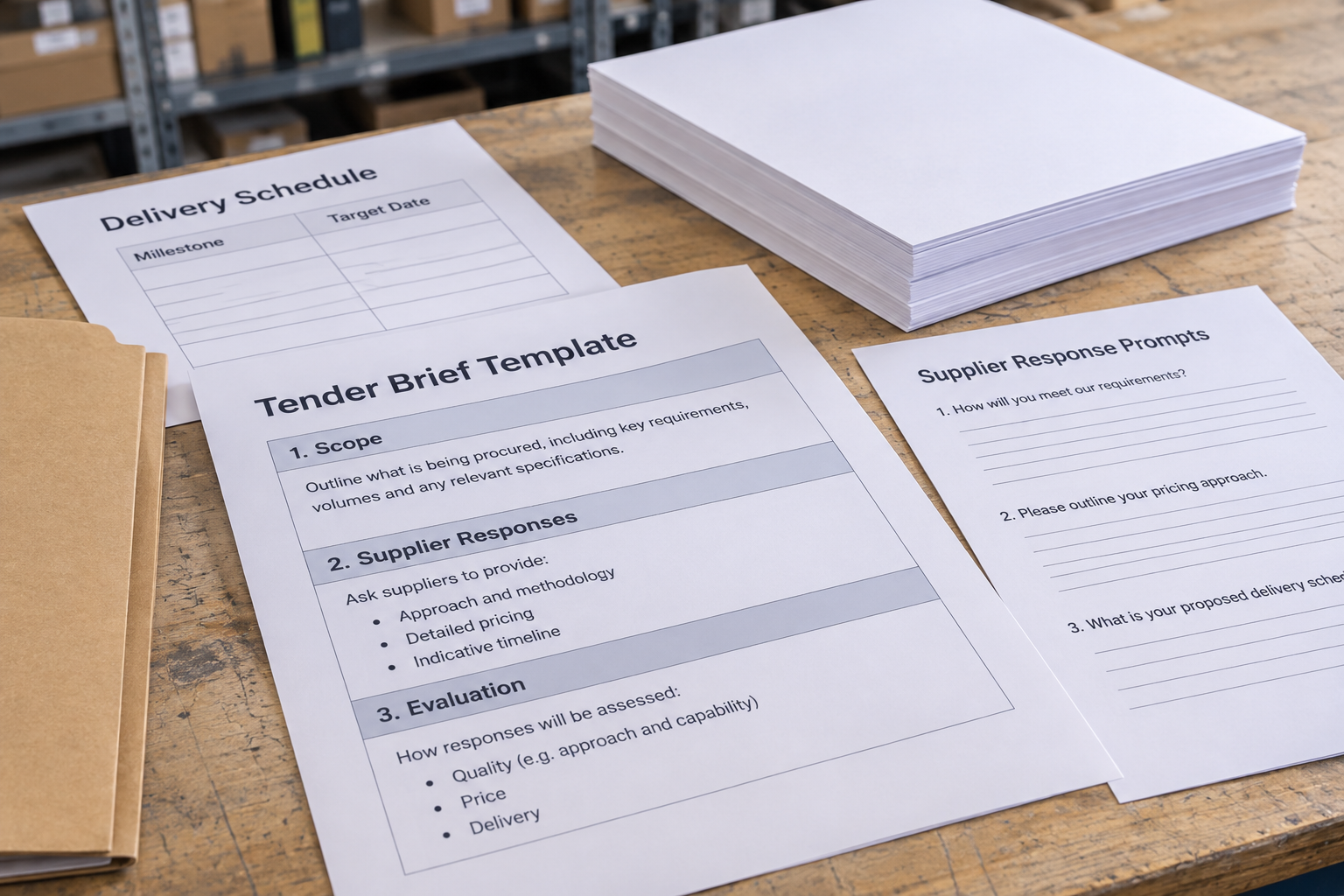
Use the sections below as a working outline. Replace each prompt with information specific to your purchase, and remove anything that does not apply. Attach detailed schedules where they would make the main brief easier to read.
| Section | What to include | Prompt to complete |
|---|---|---|
| Opportunity and background | Buyer, purpose and relevant context | We are seeking a supplier to provide [service or goods] because [business need]. |
| Scope and outcomes | Deliverables, locations, users and exclusions | The supplier will deliver [outputs] at [locations]. The work excludes [items]. |
| Requirements | Mandatory and desirable needs, quantities and service levels | Responses must explain how [requirement] will be met and provide [evidence]. |
| Commercial details | Contract duration, pricing basis and relevant assumptions | Price [units or activities] for [period], identifying optional costs and assumptions. |
| Supplier checks | Relevant financial, legal and operational information | Provide [company details and evidence] for the checks described in this brief. |
| Evaluation | Criteria, weights, scoring method and decision process | We will assess [criteria] using [method], subject to [mandatory requirements]. |
| Process and timetable | Questions, deadline, submission route and planned decision dates | Submit via [route] by [date, time and time zone]. Send questions to [contact] by [date]. |
| Contract and governance | Proposed terms, responsibilities and relevant data handling | The proposed contract is [attached or described]; identify any exceptions in your response. |
Make each attachment identifiable and give suppliers a clear way to refer to it. If an important detail is undecided, resolve it before issuing the brief where possible. Otherwise, state the assumption suppliers should use and explain how a later change will be communicated.
As you complete the outline, check that each response prompt has a purpose. For example, if suppliers must complete a pricing schedule, identify the units and period in both the schedule and the instructions. Where a response is assessed against a particular criterion, point suppliers to that criterion so they can place their evidence in the right section.
How Do You Define the Scope?
Begin with the problem, not a preferred supplier’s solution. Describe the current situation, the outcome you want and the boundaries of the work. That gives suppliers enough context to propose an appropriate approach without guessing what is included.
- Describe the need: Explain what prompted the purchase and who will use the goods or services.
- List deliverables: Name the outputs, quantities or activities expected, including any transition or handover work.
- Set boundaries: Identify locations, working hours, dependencies and exclusions.
- Identify constraints: State relevant deadlines, existing systems, site access and contract assumptions.
- Define acceptance: Explain how you will check that each significant deliverable meets the brief and who will make that decision.
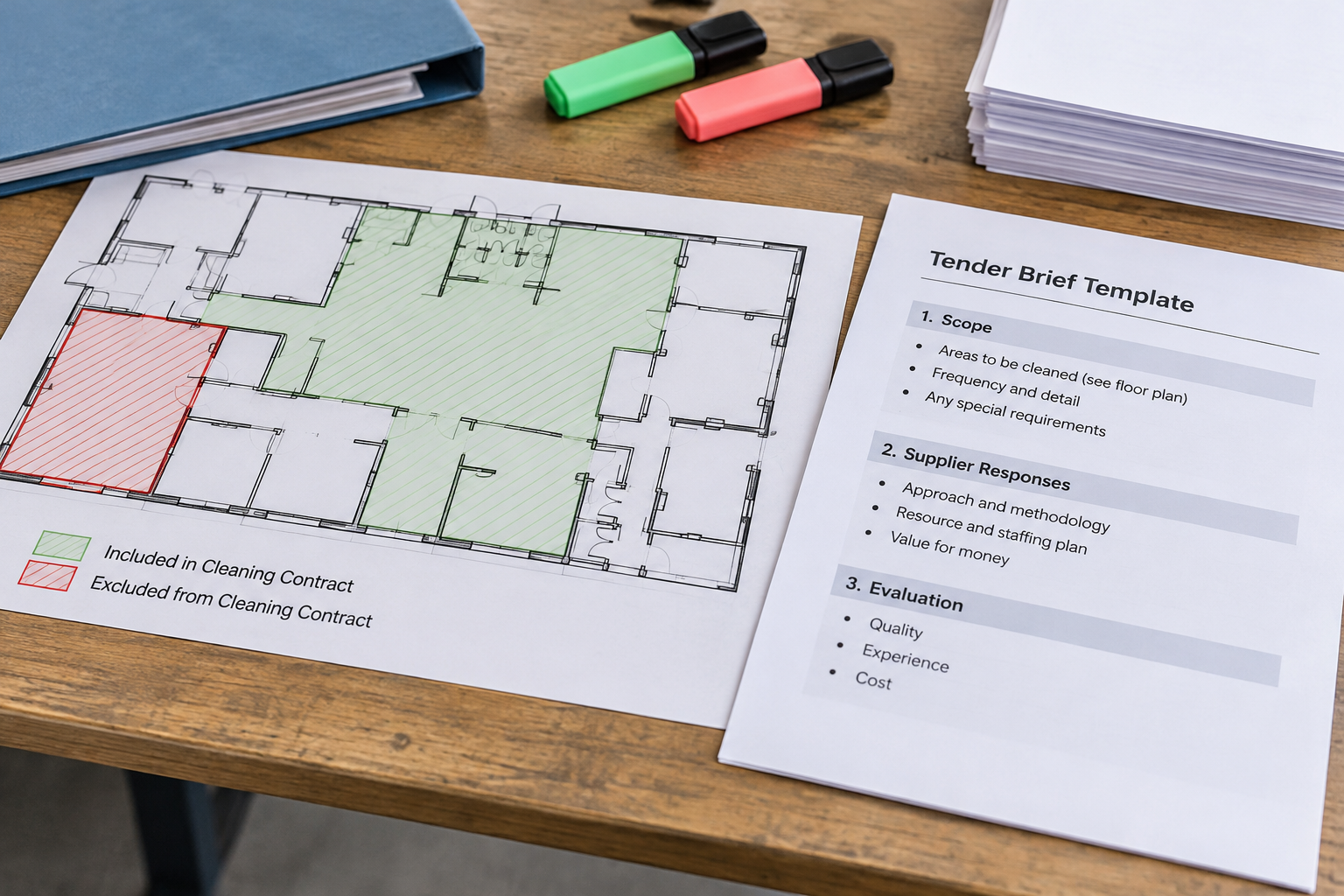
Hypothetical example: A growing business is seeking office cleaning services. Its brief could specify the sites, areas to be cleaned, expected frequency and access arrangements. It might also explain that specialist window cleaning is outside scope. Suppliers can then price the same core service rather than making different assumptions.
Avoid vague phrases such as “high-quality service” unless you explain what they mean in practice. For the cleaning example, that could mean a documented inspection process and a route for reporting missed tasks. Ask the person who will manage the contract whether the proposed scope is workable day to day.
Also identify what the buyer will provide and what the supplier must provide. In the cleaning example, the brief could state the assumed access arrangements and ask suppliers to identify any dependencies in their delivery plans. This makes it easier to spot gaps between the proposed service and the buyer’s responsibilities before a contract begins.
If the purchase is complex, separate the high-level brief from the detailed specification. The guide to writing a tender specification explains how to develop requirements that suppliers can respond to.
Which Requirements and Evidence Should You Ask For?
Turn the scope into individual requirements. Each one should describe a need, identify its importance and tell the supplier what response or evidence is expected. Numbering requirements makes questions, evaluation notes and later contract discussions easier to trace.
- Mandatory requirements: Conditions a response must meet to proceed, where appropriate. Explain how you will assess them and the consequences of a failure.
- Scored requirements: Areas where you want to compare the quality or value of different approaches.
- Information requests: Details needed for context or due diligence that are not necessarily scored. Say how you intend to use them.
For each requirement, ask for evidence that is relevant and proportionate. A service delivery plan may be more useful than a broad marketing statement; a named escalation route may be more useful than a promise of “excellent support”. Specify any format or page limit only where it helps you assess responses consistently.
Keep supplier vetting separate from assumptions about quality. You may need company details, financial information, insurance evidence or information about subcontractors, depending on the purchase. Explain what you will check, when you will check it and how an issue will be reviewed. Do not ask for sensitive information without a clear purpose and an appropriate way to handle it.
Where personal information is involved, consider what is necessary, who will access it and how long it will be kept. The Information Commissioner’s Office guidance for organisations provides a starting point for UK data protection obligations.
Finally, review requirements for accidental barriers. If an equivalent solution would satisfy the need, say so where appropriate. A stakeholder who did not write the brief should be able to distinguish a genuine minimum condition from a preference.
How Should You Set Tender Evaluation Criteria?
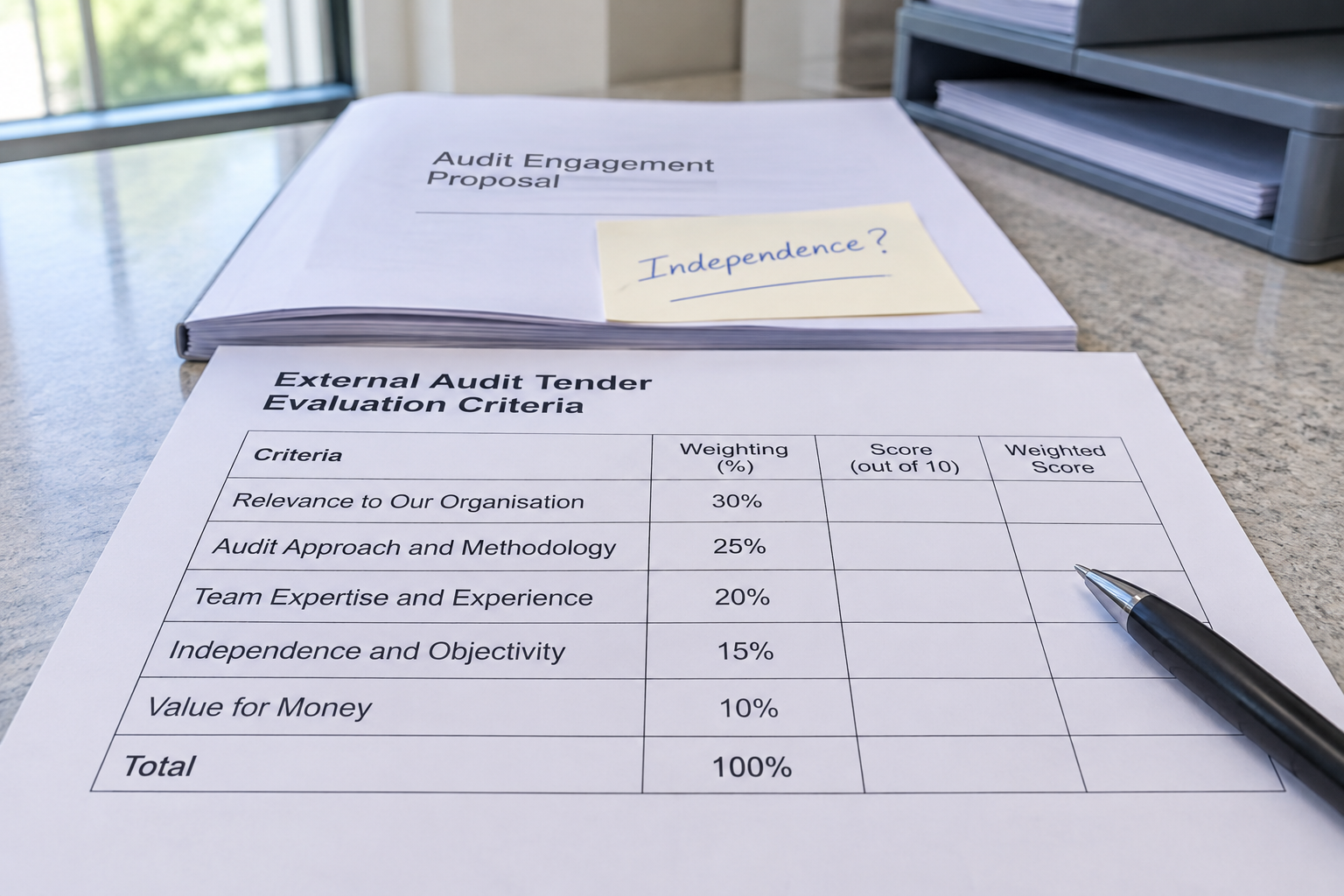
Decide how bids will be compared before inviting them. Criteria should reflect the priorities in the scope, and the brief should explain the criteria and their relative importance. Avoid collecting lengthy responses on topics that nobody plans to assess.
The following is an illustrative example for a hypothetical service tender, not a recommended weighting for every purchase. Choose weights to suit your own risk, market and objectives.
| Criterion | Example weight | What evaluators might look for |
|---|---|---|
| Service approach | 40% | A practical plan that addresses the stated scope and service levels. |
| Price | 30% | A completed pricing schedule assessed using the published method. |
| Implementation | 20% | A credible mobilisation plan, responsibilities and handover arrangements. |
| Contract management | 10% | Reporting, escalation and issue-resolution arrangements. |
Explain your scoring scale and what distinguishes a strong response from a weak one. For price, publish enough detail for suppliers to understand the comparison: the costs included, the period assessed, the treatment of optional items and the formula or other method you will use. Check that the model works for unusual but possible bids before publication.
Test the criteria using hypothetical responses. Ask evaluators to score the same sample independently, then compare their reasoning. If a criterion could reward an attractive claim without evidence, refine the question or scoring guidance before issue. Make sure the weights add up and that the pricing schedule supplies the figures needed for the published calculation.
Record the evidence behind each score and agree how evaluators will resolve differences. Named people should make the final decision, using the published process rather than changing the criteria after bids arrive. For a fuller worked scenario, see the AI-assisted tender evaluation criteria example.
If you want help turning a plain-English brief into structured requirements and weighted criteria, start your first live tender free with TenderLock. No card is required. TenderLock can check responses against requirements while named people retain the final decisions.
How Do You Run a Clear and Fair Tender?
The brief should tell every invited supplier how the process works. Set a timetable that gives suppliers enough time to understand the opportunity, ask questions and prepare a considered response. Make the deadline unambiguous by including the date, time and time zone.
- Issue the same information: Provide the brief, attachments and instructions to each invited supplier through the chosen route.
- Manage questions: Give a contact and a cut-off date. Share clarifications with all relevant suppliers where appropriate, without disclosing confidential information.
- Control changes: Version each document, record what changed and consider whether suppliers need more time to respond.
- Protect submissions: Explain who can access bids and when. A sealed process keeps bids locked until the deadline, supporting a consistent opening point.
- Evaluate and decide: Apply the published requirements and criteria, document evidence and scores, and record the authorised decision.
- Communicate the outcome: Tell suppliers what happens next and provide feedback or other notices as required by your process and applicable rules.
State how late submissions, missing information, alternative proposals and supplier assumptions will be handled. If presentations, demonstrations or clarification calls may form part of the assessment, explain their purpose and how they relate to the published criteria.
Build time into the timetable for answering questions and reviewing bids, not just for supplier preparation. Assign someone to maintain the question log and check whether an answer changes an instruction or attachment. If it does, record the affected document and communicate the update through the stated route so suppliers can identify the version they should use.
For a closer look at opening and assessing bids after the deadline, read the sealed bidding process walkthrough. Whatever method you use, keep an accessible record of the documents issued, questions answered and decisions made.

What Should You Check Before Publishing?
A final review catches problems that are easy to miss when the author already knows the project. Ask someone outside the drafting team to read the brief as a supplier would, and ask an evaluator to test whether the requested answers will support a decision.
- Clarity: Are abbreviations explained, requirements numbered and contradictory instructions removed?
- Completeness: Are quantities, locations, contract duration and essential attachments included?
- Consistency: Do the scope, pricing schedule, criteria and proposed terms describe the same purchase?
- Comparability: Can suppliers price on the same basis, and can evaluators find evidence for every scored criterion?
- Proportionality: Are supplier checks and response requests appropriate to the value, complexity and risk of the work?
- Governance: Have the right people approved the brief, timetable, budget and evaluation approach?
Try a simple red-team review: ask a colleague to find ambiguous wording, unanswered supplier questions and ways the scoring model could produce an unexpected outcome. Record the issues and their resolution rather than relying on memory. TenderLock includes Red Team reviews for ambiguity, alongside supplier checks and an audit trail.

Do one final check of filenames, access permissions and contact details. Once the brief is issued, preserve the published version and use a controlled clarification process for corrections. This helps evaluators understand which instructions suppliers were asked to follow.
Watch: Preparing a Tender Brief
For another perspective on defining scope, requirements and evaluation criteria, use this search to find a relevant practical walkthrough. Check that any advice fits your organisation’s procurement rules.
Frequently Asked Questions
What is the difference between a tender brief and a specification?
A tender brief introduces the opportunity and explains the process, including how suppliers should respond and how bids will be assessed. A specification sets out the detailed goods, services or outcomes required. For a straightforward purchase they may be combined; for a complex one, the specification is often a separate attachment.
How detailed should a tender brief be?
It should be detailed enough for suppliers to understand the need, prepare comparable responses and identify material risks. The right length depends on the purchase. A routine service may need a concise scope and pricing schedule, while a complex project may need separate technical, contractual and implementation documents.
Should a tender brief include a budget?
It can, if sharing a budget or range helps suppliers propose a realistic solution. Consider your organisation’s policy and the nature of the market before deciding. Whether or not you publish a budget, provide a clear pricing schedule and explain what costs and contract period will be assessed.
Can AI write a tender brief?
AI can help structure a plain-English description, suggest requirements and flag ambiguous wording. It cannot determine your business needs or replace accountable review. Check the output against the actual scope, applicable rules and proposed contract, and make sure named people approve the brief and make the final award decision.
What happens if the brief needs changing after issue?
Use your documented clarification or amendment process. Explain the change, issue a clearly versioned document and ensure affected suppliers receive the same information. Consider whether the change affects pricing or response preparation and whether the deadline should be extended. Follow any applicable procurement rules and internal approvals.
Ready to put your tender brief template into practice? TenderLock lets organisations run their first live tender free, with no card required, and gives invited suppliers a free way to respond.